
Analyses
The history of the Islamic Republic of Iran—established in 1979 following the revolution that overthrew Shah Mohammad Reza Pahlavi—is marked by a dense sequence of developments that have progressively altered its political and institutional configuration. These changes, however, have only sporadically been recognized by Western analyses, which have instead tended to perpetuate a more functional and instrumental stereotype based on the image of a monolithic, highly verticalized religious autocracy. While such a characterization was broadly accurate during the first decade of the Islamic Republic, it has undergone a profound transformation since 1989.
  • Ilaria Romano 25 October 2017
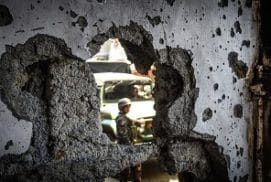
    It took no longer than two days to bring the territory back under the control of the Regional Government of Kurdistan at the end of 2014. In the space of 48 hours, the Iraqi army and the Hashd al-Shaabi shi’ite militia integrated into it took control of Kirkuk, it was swiftly followed by the recapture of Dibus, Makhmur, Khanaqin, Jalawla, Gwer, Bashiqa and Sinjar.
  • Matteo Miavaldi 18 October 2017
    On May 23, 2017, hundreds of Isis-inspired terrorists swiftly gained control of Marawi City in Mindanao, the Philippines’ southernmost archipelago. The terrorist offensive came in response to the attempted arrest of Isnilon Hapilon, leader of the Islamic terrorist group Abu Sayyaf, on behalf of the Armed Forces of the Philippines (AFP).
  • Marina Forti 9 October 2017
    We know Amitav Ghosh as a novelist. One of the greatest contemporary Indian writers, he is also a journalist and a scholar; his background as a social anthropologist is clearly visible in the rigour of the documentation behind all his novels. Ghosh also wrote extraordinary reportages and many prose pieces.  
  • 5 October 2017
    We can start from violence and its presence in the Holy Texts. Some people say that insisting on the violence of the Bible is typical of antisemitism as much as doing the same about the violence in the Qu’ran is typical of Islamophobia. But this is not the case: there are many things there as human sacrifice or lapidation that our mind cannot today accept.
  • Arturo Varvelli 5 October 2017
    Since the revolution in 2011, the Libyan crisis has increasingly imposed itself as a global issue. Particularly over the past few years, Libya has indeed moved from being a merely domestic dispute to gathering the interests of different foreign players, thus coming to represent a matter of international security
  • 5 October 2017
    Our 9 year long Istanbul Seminars have established themselves as a recognizable cultural fixture for a remarkable community of scholars. It has been able to promote and consolidate a network of cultural, intellectual and academic relationships among senior and junior scholars of the social sciences, political theory, sociology, legal and religious studies. Explore our Istanbul Seminars archive.
Load more
SUPPORT OUR WORK


Please consider giving a tax-free donation to Reset this year

Any amount will help show your support for our activities

In Europe and elsewhere
(Reset DOC)


In the US
(Reset Dialogues)


x