The Spanish government has taken an initiative that stands in sharp contrast to the line currently prevailing in Italy and across the European Union, not to mention the United States under Trump’s leadership. While the new European Pact on Migration and Asylum, set to enter into force this June, focuses on restricting the right to asylum and on deporting migrants without residence permits, the Sánchez government is introducing an amnesty expected to apply to some 500,000 people. Spain, moreover, already has 6.6 million legal immigrant residents, compared with Italy’s 5.4 million, within a total population of 48.6 million—around 10 million fewer than Italy’s. If acceptance of immigration were truly governed by quantitative limits (the so-called “tolerance threshold”), Spain should, in theory, have less room for new arrivals and regularizations than Italy and other countries.

Analyses
Migrations
- Fabio Turco 29 October 2024“Regain control, ensure security.” This is the slogan of a draft law promoted by Polish Prime Minister Donald Tusk and adopted by his government to outline the country’s migration strategy from 2025 to 2030. The proposal has sparked intense debate due to its strict measures, particularly the option to suspend the right to asylum when deemed necessary. Tusk aims to nearly eliminate “illegal” immigration by pursuing a radical approach, enacting measures that conflict with the Geneva Convention, the EU Charter of Fundamental Rights, and even Poland’s own Constitution.
- Rida Khan 9 August 2024Located in the densely populated Afghan residences of Karachi, Pakistan’s largest city, is a music center where Afghan art and culture come to life. This center is part of a community hub for Afghan refugees and their host families in Karachi. The music room is spacious enough to accommodate a group of twenty people with musical instruments shelved carefully in the corner. The music students sit solemnly on the carpeted floor, some of them playing the tabla while the others play the sitar, creating music that is a fusion of Pakistani and Afghan cultures.
- Kristina Kironska 12 July 2024The Rohingya have been forcibly displaced throughout Asia, including India, with repatriation to Myanmar deemed impossible. How are they being treated in India, a country lacking refugee laws and international commitments? According to Indian laws and the policies of the current BJP-led government, they are viewed as “aliens” who pose a security threat and are excluded by the implementation of the Citizenship Amendment Act. Do Indians endorse this view?
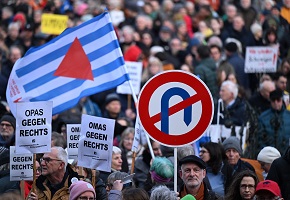
- Arghawan Farsi 22 March 2024“I’m drinking chai and eating köfte, while we still don’t feel at home here,” rapper Apsilon sings on the stage at one of Berlin’s largest demonstrations against the rise of right-wing parties. The right-wing Alternative für Deutschland (AFD) in particular has been gaining votes, especially since the influx of migrants and refugees in 2015. The demonstration drew more than 150,000 people, as diverse as Berlin itself. Rainbow flags, socialist parties, grassroots groups, social workers, and activists all stand together in front of the Bundestag to take a stand against right-wing extremism.
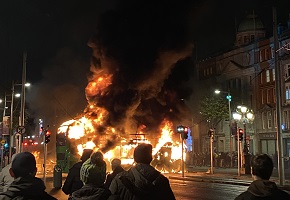
- Seán Golden 6 December 2023In the 1920s, the incipient democratic government of the newly independent Irish state managed to disarm the guerrilla forces that had fought the War of Independence by offering them the chance to become members of the new Irish police force in return for surrendering their weapons, thereby guaranteeing the state’s monopoly on violence. This means that Ireland is now faced with the dilemma of how to respond to right-wing violence while respecting the values of liberty.
- Thomas Phillips 24 November 2023Last week, the UK Supreme Court delivered its judgment on the legality of the government’s plan to send some asylum seekers to Rwanda. The ill-conceived scheme, which is based in large part on a Memorandum of Understanding between the UK and Rwanda, was unanimously held to be unlawful.
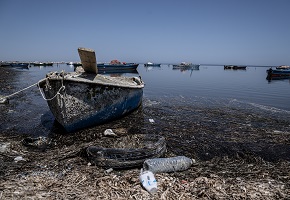
- Ilaria Romano 30 October 2023Tunisia faces challenges managing a surge in refugees and migrants, with 11,000 registered by the UNHCR, making it a major departure point for those heading to Europe. The country lacks proper infrastructure for immigration, providing minimal support to registered migrants. The EU signed a Memorandum of Understanding to address the issue, but obstacles and human rights concerns persist, with Tunisia rejecting the first EU aid installment.
- Ilaria Romano 6 October 2023A reportage about the sub-Saharian migrants who arrived in Tunisia with the idea of embarking and reaching Italian shores after grueling journeys and long periods of detention behind them, spent in migrant centers in Libya. In many of their stories, they have already attempted the crossing to the Italian island of Lampedusa, but have been stopped and sent back by the National Guard, or have been left at the mercy of the waves with their engine failing before being brought back to shore by some passing fishing boat
- Rabii El Gamrani 5 October 2023Virtual racism against sub-Saharan migrants is flourishing on social media in the Maghreb region, with groups promoting xenophobia and racist content. Conspiracy theories and fake news contribute to the spread of these narratives, portraying migrants as a demographic threat. However, in real-life interactions, racism appears to be less prevalent, as many Moroccans and sub-Saharans coexist peacefully.