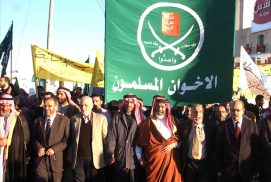
The history of the Islamic Republic of Iran—established in 1979 following the revolution that overthrew Shah Mohammad Reza Pahlavi—is marked by a dense sequence of developments that have progressively altered its political and institutional configuration. These changes, however, have only sporadically been recognized by Western analyses, which have instead tended to perpetuate a more functional and instrumental stereotype based on the image of a monolithic, highly verticalized religious autocracy. While such a characterization was broadly accurate during the first decade of the Islamic Republic, it has undergone a profound transformation since 1989.
Andrew Arato, New School for Social Research1 May 2010
This short paper will seek to explore the causes, and possible solutions of what seems to be the current freezing of the Turkish constitution making process, that has had some dramatic successes in the 1990s and early 2000s. After my previous work, comparing the major forms of modern constitution making that claim to be democratic, I have come to the conclusion that it is the legitimacy problem (rather than choice of specific model) that represents the level on which the normative justification of each process, and at least the short term chances of its success in a divided society should be tested. As a result, I make the strong claim that democratic legitimacy or constituent authority should not be reduced either to any mode of power, even popular power, or to mere legality. It is these types of reduction that I find especially troubling in recent Turkish constitutional struggles, where the legal claims of two powers, of the government controlled legislative and of the judicial branches to structure the constitution are not backed by sufficient political legitimacy. In effect these two powers that claim their constituent authorization, rather implausibly in my view, from either the democratic electorate or from an original constituent power, because of their conflict threaten to freeze the constitution making process that very much needs to be continued and concluded. I end the paper by making a suggestion for one possible constitution making procedure that would be both legitimate and legal.
«As we read in Matthew 5:13, religious believers are told: “You are the salt of the earth.” The phrase means that religious believers are expected to be neither identical with the “earth”, nor to be removed from it. In this sense, they are meant to be neither worldly-secular nor radically anti-worldly or anti-secular (thus perhaps post-secular).»
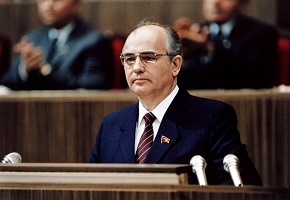
Without tacit approval from the Soviet Union, 1989 would never have happened. There would have been no peaceful and democratic mass revolts that resulted in the fall of the Berlin Wall. It is thus to Moscow, at the centre of the communist empire, that one must look, if wishing to examine the now two-decade-old epoch-making changes. An unexpected, sudden and phenomenal change that led the Eastern regimes to collapse one after the other. Two years later the Soviet Union also imploded and Mikhail Gorbachev lost his battle. We discuss these events with Andrea Graziosi, Professor of Contemporary History at the Federico II University in Naples, President of the Italian Society for the Study of Contemporary History and author of two scholarly books on Soviet history published by Il Mulino; Lenin and Stalin’s USSR and The USSR from triumph to collapse.
An interview by Matteo Tacconi.
Souad Sbai interviewed by Daniele Castellani Perelli18 March 2008
Italian Islamic consultative council and President of the Association of Moroccan Women in Italy, comes onto the field with Silvio Berlusconi’s centre-right party ‘People of Freedom’. Sbai attacks the ‘multiculturalist do-gooders’ of the centre-left while trying to win her 20th seat on the list with philosophy in Puglia, which puts her election in the balance. She thinks that immigrants should also be given the vote in political elections (“Citizenship is not necessarily required, having a stay permit should be enough”), and when we remind her that her ideas will have difficulty being accepted by the allied Northern League member Roberto Calderoli she replies: “It’s better to discuss with Calderoli than to receive indifference from Veltroni. In ten years the former mayor of Rome has never deigned to come and visit our centre”.
Mitchell Cohen (Dissent co-editor) interviewed by Elisabetta Ambrosi11 March 2008
"You have to make a choice: does the state of Israel have the same right to exist as other states or is it to be demonized like none other? If you believe it has a right to exist, then it is perflectly legitimate to criticize this or that government policy. It is another matter if your goal is really Israel’s abolition rather than a real compromise between Israelis and Palestinians," says Mitchell Cohen, professor of political science at Bernard Baruch College and the CUNY Graduate Center and co-editor of "Dissent," in his comments on left-wing and Muslim criticism of the selection of Israel as guest of honour at this spring’s International Book Fair in Turin. In response to Ramadan’s call to boycott the event, Cohen adds, "I have the impression that too many people on the left have a romance with Ramadan. It reminds me a little too much of romances with Stalinism seventy years ago."
Israeli writer Sami Michael with Daniele Castellani Perelli27 October 2006
The recent Lebanon war didn’t change the soul of Haifa. "Muslims, Jews and Christians still live together in peace, and Hezbollah’s popularity is not growing among the Arabs" passionately explains Israeli writer Sami Michael, a symbol of the city. Born in Baghdad, he has lived in Haifa since 1949. He has received many international literary awards, including the Israel Prize for Literature and the President’s Prize. For his work for peace, he has been honoured by the UN-supported Society for International Development. Author of the novels All Men Are Equal, But Some Are More, Victoria and A Trumpet in the Wadi, he was against the war from the start, but he has always strongly criticized Hezbollah. And now he says: "There is no winner, there are only losers from both sides".
Hassan Hanafi with Giancarlo Bosetti19 September 2006
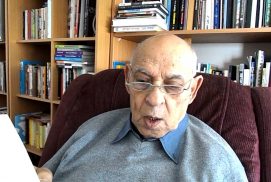
"It’s because of political conservatism that our societies today are conservative, not because of Islam" according to Hassan Hanafi, Professor of Philosophy at Cairo University, representing a proud Arab and Muslim point of view. In this interview with Reset-Doc the Egyptian philosopher explains how Islam can (and should) be interpreted as a promoting factor for social change, liberalism and secularism: "Islam can be a plus to the Europeans" he asserts "And the Mediterranean can play a key role in going beyond Occidentalism and Orientalism". Hanafi is also a member of the scientific Committee of Reset-Dialogues on Civilizations.
SUPPORT OUR WORK
Please consider giving a tax-free donation to Reset this year
Any amount will help show your support for our activities
In Europe and elsewhere (Reset DOC)
In the US (Reset Dialogues)
x
We use cookies to ensure that we give you the best experience on our website. If you continue to use this site we will assume that you are happy with it.Ok