For decades, Latin America’s authoritarian regimes were seen as a right-wing phenomenon, with Cuba as the lone exception — a dictatorship born not from a betrayal of democracy, but of revolution. As Washington’s embargo returns to the headlines, this piece asks what that framing has long obscured: that Cuba has never had just one embargo, but two.
Analyses
- Gaetano Pentassuglia 4 September 2025The mission of the Global Sumud Flotilla raises a range of legal issues linked to the likelihood of Israel intervening in international waters to block the vessels and arrest those on board. Any intervention by Israeli authorities on the Global Sumud Flotilla in international waters would constitute a breach of international law against the states whose flags the ships fly, as well as those of the foreign nationals on board, should they be arrested.
-
- Renzo Guolo 6 August 2025Driven by the messianic far right that has him in its grip, and by his personal need to prolong the war to win the next elections, Benjamin Netanyahu crosses his Rubicon and announces his intention to reoccupy Gaza permanently. The die is cast, he lets it be known, making public Donald Trump’s support for the announced reoccupation of the Strip.
- Riccardo Cristiano 1 August 2025The upheavals concerning the area we call the Holy Land, where Jesus preached and which today spans Israel and the Palestinian Territories, inevitably involve the Christians living there. To grasp their significance, it’s useful to start with a Franciscan who was a passionate scholar of Judaism, later becoming Custos of the Holy Land and then Latin Patriarch of Jerusalem—the first patriarch to become a cardinal, Pierbattista Pizzaballa. How can we define him? Using the term he chose when elected in 2020: the “patriarch of remaining.”
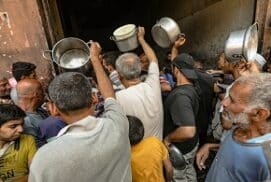
- Claudia De Martino 16 July 2025Many media outlets highlight how Israel is increasingly isolated in the West regarding Gaza. According to a Pew Research Center survey, the number of pro-Western states—above all Australia, Indonesia, Japan, and Turkey, and in Europe, Spain, Sweden, Greece, Ireland, and the Netherlands—that hold a negative perception of Israel is growing. The Israeli government and army continue to present the current military intervention—Operation “Gideon’s Chariots,” launched last May—as a necessary response to the “existential threat” posed by Hamas, while a growing part of the international community can no longer perceive any danger in the starving masses of Palestinians wandering around food distribution centers in constant danger of being killed.
- Riccardo Cristiano 11 July 2025United by geography and a long history that, since the end of the Ottoman Empire and especially during the long rule of the Assads, has taken on the characteristics of colonialism and occupation in the name of a “Greater Syria,” Lebanese and Syrians today share the same hope: that tomorrow will be different from today, putting an end to conflicts and reducing them to “wars of the past.” Reality demands this. In 2018, Lebanon’s GDP exceeded 55 billion dollars; today, it barely reaches 20 billion. One hundred thousand Lebanese pounds, which were worth 65 dollars at that time, are now worth just one. In Syria, in 2011, when the brutal repression of anti-government protests began, GDP reached 45 billion dollars; today it is only 9 billion.
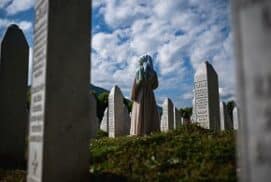
- Besa Ismaili 11 July 2025Three decades have passed since the genocide in Srebrenica, three decades since over 8,000 Bosniak Muslim men and boys were systematically executed, while international forces, under a United Nations mandate, stood by, disabled to act.Though long delayed, the 2024 UN General Assembly resolution recognizing July 11 as the International Day of Remembrance for the Victims of the Srebrenica Genocide marked an important, yet symbolic step toward truth-telling. It seeks to institutionalize memory, counter persistent denial, and affirm the gravity of the atrocity. Yet symbolism alone cannot substitute justice.
- Hussein Ibish 7 July 2025The U.S. has never been short of hideous or harebrained legislation from both liberals and conservatives. But President Donald Trump’s “Big Beautiful Budget Bill,” passed on Thursday by Congress, outdoes anything in living memory. In one gigantic sweep, it enacts at least four major national initiatives, each of which would alone qualify as among the most appalling legislative acts in modern American history.
- Pegah Zohouri 4 July 2025Two weeks after the ceasefire that halted the twelve-day war between Israel and Iran, regional tensions remain high, and domestic reverberations within Iran continue to unfold. While the conflict briefly united a politically fragmented society, it also exposed deep structural fissures. Most Iranians rejected foreign intervention, reaffirming a longstanding scepticism rooted in historical memory and national experience. Although critical of the current system, most of them seemed to agree that meaningful and sustainable transformation could only emerge from within.
- Daniele Archibugi 30 June 2025It is certainly surprising that, in the middle of major international conflicts (such as the Russian invasion of Ukraine, the repeated massacres in Gaza, and the Israel–Iran war), the United Nations Security Council has not been able to play the role of mediation that the UN Charter contemplated. The UNSC has gathered daily, and its permanent and elected members have discussed both minor and major crises, but without being able to agree on any Resolution regarding the most important events. By itself, this would not have been a major change: in the Cold War, many UNSC Resolutions were blocked by either the USA or the USSR veto. For far too long, two major blocks operated in opposite directions: on one side, the liberal democracies led by France, the United Kingdom, and, above all, the United States, and on the opposite side, the Soviet Union – and later Russia – supported by China.