For decades, Latin America’s authoritarian regimes were seen as a right-wing phenomenon, with Cuba as the lone exception — a dictatorship born not from a betrayal of democracy, but of revolution. As Washington’s embargo returns to the headlines, this piece asks what that framing has long obscured: that Cuba has never had just one embargo, but two.
This election was about the sex of state. In the eyes of millions of his supporters, particularly the men who made him President, America’s manhood is at stake. Donald Trump ran as an erect phallus, a sexually aggressive man who can break through the forms, crush our enemies and make the American body politic strong once again.Trump did not run on a policy platform. People voted for his dick. Never before has a candidate for the American Presidency defended his penis size, let alone a prime-time debate, assuring us that his small hands do not mean anything else is small. “I guarantee you, there’s no problem. I guarantee you,” he shot back at a primary debate. One of the rally posters for Trump now circulating proudly exhorts: “Don’t’ be a pussy! Vote Trump.”
The expansion and consolidation of the Hindu Right’s political power has raised legitimate concerns about the future of India’s secularism. While criticism of secularism could be found in the public debate during the anti-colonial struggle, the sustained assault on it became particularly apparent during the Ayodhya movement. During the late 1980s and 1990s, the public campaign led by the Bharatiya Janata Party (BJP) advocated that the practice of secularism has led to the appeasement of Muslims. The BJP further argued that it has been quite harmful to India’s democratic polity because it has been institutionalising vote-bank politics, and that what is needed is in fact an attempt for a ‘positive’ secularism as opposed to ‘negative’ secularism. While these distinctions were widely used during those days, surprisingly it has vanished from the political lexicon of the Hindu Right in recent years.
Long before the final results, many Americans knew that our body politic was suffering a seizure after being injected with a poison that nothing in Hillary Clinton’s politics was potent enough to expel. The impotence of that politics — its inability to draw from wellsprings deeper than bromides about breaking glass ceilings, “fighting” for families and children, and slashing college tuition — has little to do with Clinton’s character or alleged corruption or even with the undoubted wave of misogyny in this election.
October 2016, New Delhi – Milan
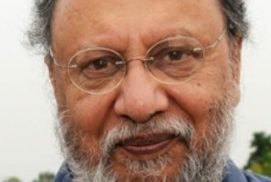
Ashis Nandy sees vendors of nationalism inflicting damage all over the world, including in his own country, India. In India, the modern ideologies dominant during the liberation struggle against British rule were anti-colonialism and anti-imperialism. These then gave way to secular nationalism after Independence in 1947, under the first Prime Minister of free India, Jawaharlal Nehru (d. 1964). But less than seven decades later, what dominates Indian politics today is Hindu nationalism or “Hindutva”, and this is now being aggressively promoted by the ‘strongman’ currently leading the government in Delhi, Narendra Modi. Nandy, 79, a clinical psychologist by training, an analyst of culture and society, an astute political commentator and today India’s most significant living public intellectual, has embraced the view of one of India’s founding fathers, Rabindranath Tagore, who thought that the idea of Indian nationalism was as absurd as Switzerland having a navy. In this interview below, Nandy will explain why.
Two years after the publication of An Uncertain Glory: India and Its Contradictions, Indian economist and philosopher Amartya Sen of Harvard University returns to focus on the relationship between identity and violence. The Country of First Boys appeared a few months ago in bookstores as a collection of Sen’s essays made available with the contribution of Antara Dev Sen and Pratik Kanjilal. In it, the Bangladeshi-born economist updates his earlier reflections on ‘identity politics’ and its relationship with extremism and violence, both at the inter-ethnic as well as at the international level.
Once upon a time, not that long ago, it was a crime to go to the beach wearing skimpy clothes. Nowadays, at least in France, it is crime to appear on a beach if excessively overdressed. Bikinis and topless swimsuits were forbidden in the name of rules governing public morals and behaviour that forbade women from showing off too much of their bodies. According to Prime Minister Manuel Valls, burkinis are not compatible with new French public morals established by the republic’s values and women’s emancipation. An excessively covered-up woman is not sufficiently secular and independent.
We publish the review that Jim Sleeper wrote in 2013 for the Columbia Journalism Review on Zev Chafets’s book Roger Ailes Off Camera.
When I published Liberal Racism in 1997 (with a chapter on how The New York Times was misrepresenting racial politics under editorial-page editor Howell Raines), I was interviewed on Fox News, which I’d barely heard of, by Bill O’Reilly, whom I hadn’t heard of at all. The encounter was anodyne, but before long I noticed that the network was not. Under its president Roger Ailes, who had pitched his vision of Fox to a receptive Rupert Murdoch only a year before I met O’Reilly, it was rapidly becoming what Zev Chafets calls “transformational” in American media and political culture. By treating journalism as if it’s all about ratings and show, Fox actually makes a profoundly political statement by eviscerating what democratic politics really stands for.
Reset-Doc is pleased to publish and support the letters concerning recent events in Turkey that hundreds of academics, intellectuals and politicians, from around the world, have sent both to the US Government Officials, Barack Obama, John Kerry and Ashton Carter, and to the Highest Officers of the European Union, Federica Mogherini and Thorbjørn Jagland. While they disapprove the attempt to subvert the democratic process in Turkey through the military coup, these letters have been written to strongly condemn actions taken by the Turkish government in violation of human rights and rule of law. The undersigned, therefore, are calling to action the US government and the European Union to strongly criticize these violations, to closely monitor the situation and refuse to accept anything but the reversal of these authoritarian policies.
Military coups and Turkey. For years this seemed to be an indissoluble dyad. Even in 2007, when a general election was held, the foreign press, including Italy’s, poured into the country fearing a coup d’état. Nothing of the sort. Erdogan’s AKP’s continuous victories seemed to be a sign of stability and of a democratic process that appeared to have quashed the danger of military intervention that until just a few years ago had characterised Turkish history.
According to many recent studies, Muslims’ political history reveals certain particular processes and ideas, which is obvious since all historical processes differ, but at the end of the day result in one and the same universe encompassing them all and one that has ended up creating the practices, schools of thought and symbols adopted by Muslims. While, for example, this concerns Islam’s political language, or kingdom of God, or oriental despotism, etc., it appears to evoke a universe that is totally extraneous to everything that Europe has practiced and believed. As one will see, in observing the events rocking the Muslim world, a contemporary researcher has even suggested that there has been a fall and resurrection of the Islamic State (overturning the words of the famous book, Decline and Fall of the Roman Empire).
We use cookies to ensure that we give you the best experience on our website. If you continue to use this site we will assume that you are happy with it.Ok