For decades, Latin America’s authoritarian regimes were seen as a right-wing phenomenon, with Cuba as the lone exception — a dictatorship born not from a betrayal of democracy, but of revolution. As Washington’s embargo returns to the headlines, this piece asks what that framing has long obscured: that Cuba has never had just one embargo, but two.
Analyses
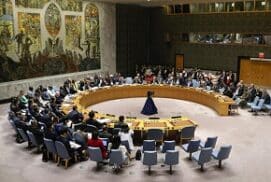
- Daniele Archibugi 30 June 2025It is certainly surprising that, in the middle of major international conflicts (such as the Russian invasion of Ukraine, the repeated massacres in Gaza, and the Israel–Iran war), the United Nations Security Council has not been able to play the role of mediation that the UN Charter contemplated. The UNSC has gathered daily, and its permanent and elected members have discussed both minor and major crises, but without being able to agree on any Resolution regarding the most important events. By itself, this would not have been a major change: in the Cold War, many UNSC Resolutions were blocked by either the USA or the USSR veto. For far too long, two major blocks operated in opposite directions: on one side, the liberal democracies led by France, the United Kingdom, and, above all, the United States, and on the opposite side, the Soviet Union – and later Russia – supported by China.
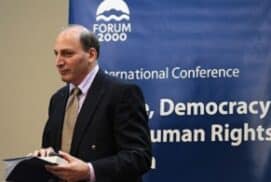
- Giancarlo Bosetti 21 June 2025Ramin Jahanbegloo, one of Irans preeminent intellectual figures, attends the conference ‘Peace, Democracy and Human Rights in Asia’ held under the auspices of former Czech president Vaclav Havel on September 11, 2009, in Prague. Other guests of this conference are Tibetan spiritual leader the Dalai Lama, former President of South Africa and Nobel Peace Prize Laureate Frederik Willem de Klerk, Rabiya Kadeer, head of the World Uighur Congress, Robert Menard of France, former Secretary-General of Reporters Without Bord and others philosophers and disidents.AFP PHOTO MICHAL CIZEK (Photo by MICHAL CIZEK / AFP)
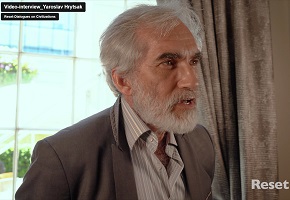
- Alessandra Tommasi 20 June 2025“I’m ready to meet anyone, including Zelensky.” Vladimir Putin’s recent statement suggested a openness to renewed negotiations – though only “in the final phase.” But skepticism remains high in Kyiv and across Western capitals. The Kremlin’s latest proposal – disarmament, new elections, and ceding of occupied territories – was flatly rejected by Ukraine. Meanwhile, Russia continues to escalate military pressure: just last Tuesday, it launched over 440 drones and 32 missiles in one of the most intense attacks since the war began. Against this backdrop, Reset DOC interviewed historian Yaroslav Hrytsak about Ukraine’s military position, diplomatic deadlock, Western support, and prospects for peace.
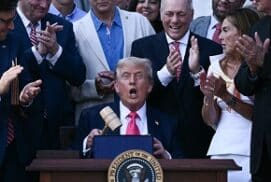
- Hussein Ibish 16 June 2025It’s a real-life film noir in the City of Angels. U.S. President Donald Trump is once again hurling Americans through the looking glass, this time – fittingly – in Los Angeles. It feels lifted from 1930s hard-boiled pulp fiction in which nothing is as it appears and everything is the inverse of what powerful men assert. It’s genuinely shocking, while also seemingly inevitable, that U.S. military forces are being deployed to major cities with the express purpose of trying to intimidate, quash, and, ultimately, violently confront Americans who dare raise their voices against Mr. Trump’s policies and practices. It is one of the most significant inflection points since the last election took America on the road away from constitutional democracy and towards the kind of repressive lawlessness this President admires in other leaders and is seeking to emulate in the U.S.
- Alessandra Tommasi 12 June 2025“I’m proud to be called a normalizer by the Muslim Brotherhood’s affiliates.” That’s how Dubai-based blogger Loay Alshareef responds to attacks from across the Arab world, where the majority still oppose full recognition of the State of Israel. A practicing Muslim of Saudi origin, Alshareef doesn’t shy away from controversy: he openly defines himself as a “Zionist” and sees the Abraham Accords not as a betrayal of the Palestinian cause, but as a path to peace. On June 11, 2025, the activist and influencer took part in a roundtable discussion in Bologna, Italy, focused on combating antisemitism – an occasion on which Reset DOC spoke with him to share his views on the ongoing war in Gaza.
- Giancarlo Bosetti 28 May 2025After the publication of Postliberalism: The New Politics of Meaning (2021), by Adrian Pabst, the ranks of those criticizing liberalism and liberal democracies have grown – particularly those who take upon themselves the task of moving beyond a political phase marked by discontent and the erosion of democracy on a global scale. Some authors attempt to give meaning to this “post” by framing it as an alternative to both neoliberalism and populism. These include conservative thinkers (like Patrick Deneen), religious and theologically engaged figures (like John Milbank), and others who push their critique of liberal universalism to the edge of reactionary extremism (like Yoram Hazony), to the point that they appear more anti- than post-liberal. Pabst, a British political philosopher and Catholic, represents a more moderate, reformist version of this trend. He argues that modern liberalism has exhausted its capacity to give meaning to political, social, and economic life – because radical individualism, combined with a socially unbound market and a technocratic state, has reduced the human being to a consumer.
- Emma Fattorini 15 May 2025What will it mean to have an Augustinian at the helm of the Catholic Church? A Church followed, on paper, by a billion and a half faithful, predominantly strong in what are increasingly becoming the world’s peripheries. Far from a West that seems to be fragmenting.
- Danilo De Biasio 13 May 2025The re-election of US President Donald Trump has played a key role in prompting the launch of the ReArm Europe Plan, an initiative aimed at advancing Europe’s strategic military autonomy. Notably, the plan does not establish a common European defense force. Rather, it sets up a shared fund – worth €800 billion – to support individual EU member states’ military expenditures. To better understand the implications of this shift, Reset DOC spoke with Dan Smith, Director of the Stockholm International Peace Research Institute (SIPRI) and one of the world’s leading experts on armed conflict, defense policy, and disarmament.
- Hussein Ibish 12 May 2025From May 13-16, President Donald J. Trump will repeat the opening gesture of his first administration by making the initial major diplomatic travel of his second term to Saudi Arabia (excluding his unanticipated visit to Rome for the funeral of the late Pope Francis) but this time also including the United Arab Emirates and Qatar. This trip comes at a highly significant moment in U.S.-Gulf Arab relations, and all parties will have specific agendas and deliverables at stake. Overall, Trump’s trip reinforces the centrality of these partnerships for all sides and signals that he continues to view Gulf Arab countries as important partners, not just for the United States but for his personal and political goals.
- Ilaria Romano 10 May 2025According to the Center for Civil Liberties (CCL), a Ukrainian human rights organization that has been documenting war crimes since 2014 in Crimea, Donetsk, and Luhansk — and since 2022 across all occupied territories — at least 7,000 civilians are currently being held illegally. However, only 1,600 of those cases have been officially confirmed. The remaining 5,400 are listed as missing and may be in the same situation.