
Videos
-
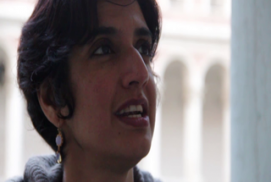
 Ananya Vajpeyi 23 September 2013“Swaraj literally means ‘selfrule’: it joins together the idea of the self and the idea of sovereignty, rule, or mastery. Swaraj was used most in the late nineteenth century and throughout the first half of the twentieth century to indicate the major political project that Indians were engaged in, through a number of anticolonial, nationalist movements and other kinds of political responses to the fact of British rule and British empire. Most histories of Indian nationalism or of India during that period tell the story of how India became politically independent and how it succeeded in ending British rule. But I couldn’t find any good narrative about the search for the ‘Self’, which is the “Swa” in the first half of Swaraj.” That is why Ananya Vajpeyi, Kluge Fellow at the The John W. Kluge Center of The Library of Congress in Washington D.C., has selected five key figures of India’s modern thought, politics and culture – Mahatma Gandhi, Rabindranath Tagore, Jawaharlal Nehru, B.R. Ambedkar and Abanindranath Tagore – to understand how they tried to find values and norms that could be set up as the scaffolding for a future India. We interviewed her during the Venice-Delhi Seminars 2012, held at the Giorgio Cini Foundation in Venice. Ananya Vajpeyi is the author of Righteous Republic. The Political Foundations of Modern India, Harvard University Press, 2012 Interview by Nicola Missaglia Videomaker: Ruben Lagattolla More about Venice-Delhi Seminars here Discover the September 2013 Issue of Seminar magazine, with contributions from the Venice-Delhi Seminars 2012
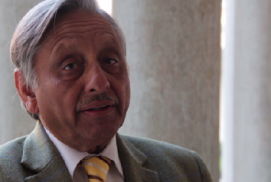
 - 5 September 2013“I think the central issue before India at 66 years from its declaration of independence is that, whereas at the start we assumed that both democracy and development are desirable and can be secured together, increasingly we are facing a dilemma of democracy and development. An the reason for that is, that as our economy grows faster and faster – as it has been doing particularly in the last decade – we discover that higher growth leads to wider inequalities…and that a lot of the development process involves disruption. This is illustrated by the fact that about 65 million tribal Indians have been displaced as a result of development based on attempting to discover minerals and loose timber. In these circumstances democracy – which has become a grounded reality in India – has to find an answer in reconciling the growth of GDP with its impact on the people,” explains Mani Shankar Aiyar, an Indian MP and former diplomat and minister, interviewed at our Venice-Delhi Seminars 2012 at the Giorgio Cini Foundation in Venice, Italy. Mani Shankar Aiyar is a former diplomat, Member of Parliament (Rajya Sabha), India; Chairman, Expert Committee, Panchayat Raj Institutions, Delhi Interview by Nicola Missaglia Videomaker: Ruben Lagattolla More about Venice-Delhi Seminars here Discover the September 2013 Issue of Seminar magazine, with contributions from the Venice-Delhi Seminars 2012
- 24 July 2013“What has happened with the advent of people from former colonies and because of intensified globalization, is that for the first time in the history of modern Western Europe you begin to see a religious diversity that Europe has not witnessed before. The social and institutional arrangements in Europe are not adequate to deal with this diversity: they were adequate only do deal with the problems of a single religion, of accommodating that religion, or to fight against the excesses of that religion. Now you suddenly have multiple religions and Europe is really at a loss what to do with these religions. The European Union has a much better resource – because it has a much more universal perspective – but each society is still bound by its own arrangements and so they are feeling the strain”. This often leads to a defensive attitude towards diversity. But how can this wall of defense be broken? We asked Rajeev Bhargava, former Director of the Centre for the Study of Developing Societies in New Delhi, India.
- 10 July 2013Throughout history, European “corporations” helped develop strong civil societies and democracies while the so-called “waqf”, or Islamic trusts, delayed the rise of autonomous non-governmental associations capable of providing the checks and balances essential to democratic rule and thus, favored the emergence of autocracies. The Islamic tax – the ‘zakat’ – and inheritance laws fragmentized the commercial sector which failed to produce lasting constraints on rulers and bargaining effectively with the State. Does this mean that there are normative aspects of Islam which have hindered democratization and economic growth? At our Istanbul Seminars 2012, we have asked Timur Kuran, Professor of Economics and Political Science, and Gorter Family Professor in Islamic Studies at Duke University. – Filmmaker: Anna FanueleInterview and text editing: Nina zu Fürstenberg
- Seyla Benhabib 14 June 2013“Is the Westphalian map still helpful in a globalizing world?” asks Political philosopher Seyla Benhabib from Yale, “or do we rather need to start thinking across borders and boundaries to really achieve democracy and find solutions to the transnational claim for rights?”. Interviewed during ResetDoC’s Istanbul Seminars, she suggests we should start considering transnational sights of democracy and rights claims across the porous national borders of our globalized world.Watch Part 1 of this Video
- Seyla Benhabib 29 May 2013Do universal rights claims need to be contextualized? And how does this happen? At our Istanbul Seminars, we asked Professor Seyla Benhabib from Yale University. How do the voices of the excluded – women, immigrants, minorities – get included into the public sphere? Through a process of democratic iterations and jurisgenerativity – Prof. Benhabib explains – linking the normative, utopian aspect of legal claims and the very process of questioning, confrontation and dialogue. Rights always require interpretation or, to be more precise, iteration in a specific context. Watch part 2 of this video
- Akeel Bilgrami 30 April 2013“I am very interested in the concept of identity in politics, that is how people allow themselves to be mobilized in politics on the basis of something that theorists, as well as people in ordinary talk, call their ‘identities’. I try to define the concept of identity in terms of people’s fundamental and deepest commitments: this means that I am interested in a notion of identity in which people endorse certain things about themselves and make them into commitments…it could be their gender, their nationality or their race”, says political philosopher Akeel Bilgrami from Columbia University. But what happens to our liberal doctrines and liberal ways of understanding the polity when one finds people mobilized on the basis of identity? We asked Professor Bilgrami during a past edition of our Istanbul Seminars.
- Zaid Eyadat 10 April 2013“Islam has been used and politicized, so not having a secular state is a danger for the nature of Islam itself”, says Zaid Eyadat, professor for political science at Jordan University, interviewed during Reset-Dialogues’ Istanbul Seminars 2011. The so-called “Amman message” has opened dialogue and discussion among scholars and the Arab Spring triggered important social change. Now people demand their voices to be heard.Interview by Nina zu FürstenbergFilmmaker: Nikolai EberthEditing: Anna Fanuele
- 4 March 2013“Society needs symbols, myths, narratives…and modernity cannot just be rationalization”, explains Jeffrey Alexander, Lillian Chavenson Saden Professor of Sociology and Co-Director, Center for Cultural Sociology at Yale University. “We need to understand the power, the energy and the glue that keeps civil society together and motivates people”, from Occupy to Tahrir Square, says Alexander, by trying to redefine the cultural in social theory. Myths, narratives and iconic symbols have disappeared in the course of modernization… But how can cultural sociology bring these important ideas back to the theory of democracy? Reset-Dialogues has interviewed Jeffrey Alexander at Istanbul Seminars.
- 15 February 2013In order to create a new democratic political order the initial transformation process needs even more participation and a democratic constituent power, argues political scientist Andrew Arato at Reset-Dialogues’ Istanbul Seminars. Democracy making is a consensual process with an active input from civil society groups, and not just from elites. In Egypt this constituent democratic form never really emerged yet, also because the Brotherhood allowed the military to impose its own rules, asking for quick elections in return. Andrew Arato is the Dorothy Hart Hirshon Professor of Political and Social Theory in the department of sociology at The New School University, New York City.