

Videos
-
 Claus Leggewie 25 May 2026Political scientist Claus Leggewie reflects on the transformation of democratic discontent into what he describes as a “right-wing radical” assault on liberal institutions, while also exploring possible democratic responses rooted in civic participation and institutional reform.
 - Julián Casanova 25 May 2026Historian Julián Casanova examines the continuities and differences between past and present forms of authoritarianism, warning that contemporary anti-democratic movements no longer seek to overthrow democratic institutions from the outside, but increasingly undermine them from within.
- Adrian Pabst 25 May 2026Political theorist Adrian Pabst outlines his idea of a communitarian and internationalist post-liberalism—a model that seeks to move beyond both atomized individualism and nationalist closure without abandoning the fundamental liberties of the liberal tradition. Reflecting on the role of intermediary institutions, civic participation, religion, and economic democracy, Pabst proposes a plural and relational political order capable of rebuilding the social fabric eroded by both market absolutism and technocratic governance.
- Anina Schwarzenbach 25 May 2026Anina Schwarzenbach reflects on how inequality, alienation, and the erosion of trust in institutions can fuel resentment, extremism, and even political violence.
- Camila Vergara 25 May 2026In an age marked by democratic fatigue, distrust in institutions, and the rise of competing populisms, political theorist Camila Vergara argues that democracy can only be renewed by giving ordinary citizens a direct and lasting role in political power. In this interview, she reflects on her idea of “plebeian constitutionalism,” a model that seeks to move beyond elite-driven politics by creating institutional spaces for collective participation, civic engagement, and bottom-up democratic control.
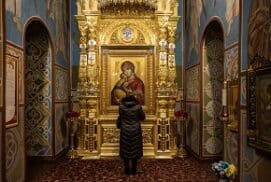
- Editorial Board 22 January 2026It is impossible to understand the Russia–Ukraine conflict—or to envision a path to peace—without examining the ecclesiological dimension of relations between Moscow and Kyiv. Kyiv has been regarded as the cradle of Russian Orthodoxy since the tenth century, making religious authority and identity deeply intertwined with political power in the region. In Ukraine today, over 72 percent of the population identifies as Eastern Orthodox. For decades, Ukrainian Orthodoxy was largely structured around churches linked to the Moscow Patriarchate, which rejected any ecclesiastical separation from Kyiv. This arrangement was dramatically challenged in 2018, when Patriarch Bartholomew I established the autocephalous Orthodox Church of Ukraine. Although this church now claims the allegiance of more than half of Ukraine’s Orthodox believers, it has never been recognized by Moscow.Reset DOC’s new documentary by Filippo Macelloni, “The Russia–Ukraine Conflict and the Role of the Orthodox Church”, examines how religion, identity, and geopolitics intersect at the heart of Europe’s most devastating war.
- John Milbank 19 October 2025John Milbank reflects on the fragility of Western liberalism, arguing that no civilization can endure without a unifying religious narrative at its core. As Christianity recedes, he warns, Western societies risk fragmentation, isolation, and a growing attraction to authoritarian models. Recovering the Christian foundations of dignity, freedom, and communal life, he suggests, is essential for the West’s future.
- Seán Golden 6 April 2025In contemporary Chinese political discourse, “harmony” is one of the key words defining the vision promoted by China’s leadership—a concept deeply rooted in Confucian philosophy. What does this notion mean in practice, and how does it shape China’s understanding of power, peace, and global order? Sean Golden, senior associate researcher at CIDOB, traces the historical and philosophical origins of the “Confucian Peace,” contrasting it with the militarized traditions of Chinese statecraft.
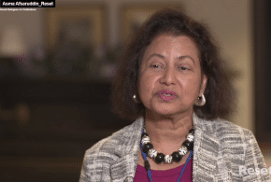
- Asma Afsaruddin 17 January 2025Asma Afsaruddin, professor of Islamic studies at Indiana University, talks about the challenges of achieving peaceful coexistence in the Israeli-Palestinian conflict. She highlights the need for equal rights and justice for all, pointing to the absence of a Palestinian state as a major obstacle.
- Ruth Hanau Santini 28 October 2024Ruth Hanau Santini, associate professor of Politics and International relations at the University of Naples L’Orientale, discusses how Tunisia’s democratic backslide stemmed from unimplemented reforms and an elite-driven process that sidelined public trust. These issues ultimately paved the way for populist influence, culminating in Tunisia’s current political crisis.