While international attention is focused on the war with Iran—due to its implications for the global energy market and the threat of a potentially devastating escalation—fighting between Pakistan and Afghanistan has resumed with unprecedented intensity in the adjacent region. Such a clash would have been unthinkable when the Taliban returned to power on August 15, 2021, reestablishing the Islamic Emirate of Afghanistan, in part thanks to Islamabad’s support.
What, then, can humanity do in the face of this lack of common sense on both sides? Perhaps the only way to stop this war and the spread of violence across the Middle East is a shared commitment to peace and to the value of human life, whether Muslim, Jewish, or Christian. We need a minimal morality that could inspire opposition to Iranian tyranny, alongside a strong turn toward common sense—on that recalls the American tradition of civic virtue: the dedication of citizens to the common good and placing public duty above self-interest. Believe it or not, Iranian civil society today is closer to some of the values of the American Revolution than some of those who work in Washington, D.C. and wage wars to expand their capacity to make war. If the 2003 war in Iraq was unjust, the war against Iran is a war against common sense—and against the civic virtues of the Iranian people.
The recent large-scale deployment of U.S. forces in the Middle East and Europe has led many analysts to question whether a military intervention in Iran is on the horizon—and what its short- and long-term consequences might be. An action capable of bringing about the collapse of the Islamic Republic would open political and religious scenarios with global ramifications.
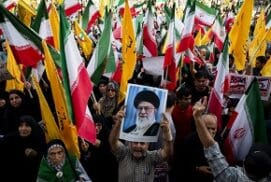
The protests over Iran’s economic crisis are putting the regime under severe strain. They risk acting as a detonator for an already highly unstable mix: the heavy impact of sanctions, the collapse of the rial to historic lows against the dollar, and an unprecedented energy and water crisis. These factors, compounded by systemic inefficiencies, are driving inflation to around 40 percent year on year. Taking to the streets are Tehran’s bazaar merchants, a group long decisive in determining whether power in Iran holds or collapses.
Over the past two years, Iran has suffered the most significant blows to its deterrence capacity since the founding of the Islamic Republic, losing much of the regional influence it once wielded through loyal proxies in Iraq, Syria, Lebanon, and even Yemen. Once able to mobilize allied forces across the Middle East in pursuit of shared interests against Israel, Tehran now faces a drastically diminished strategic position. Following Hamas’s October 2023 attacks, Israel systematically targeted Iranian proxies—crippling Hamas in Gaza, weakening Hezbollah in Lebanon, and, with the collapse of Bashar Al-Assad’s regime in December 2024, depriving Iran of its crucial Syrian ally. Subsequent Israeli strikes deep into Iranian territory further exposed Tehran’s intelligence failures, limited military reach, and diplomatic isolation. Yet the current retrenchment of Iran and its allies does not signify collapse; rather, it represents a phase of strategic recalibration within an evolving regional order characterized by multi-alignment and shifting power centers.
What are the defining features of the hypothetical “new Middle East” emerging after the tragic events of October 7, 2023? Beyond the unspeakable tragedy unfolding in Gaza—a catastrophe not only of immense humanitarian proportions but also of deep political inconsistency—several recent developments stand out. These markers help illuminate the ongoing attempt to reshape the region, not necessarily toward lasting stability, but more plausibly toward a provisional armistice. Such a phase, though conditional, would nonetheless be welcome if it could create the groundwork for a genuine space for negotiation on the fundamental issues of the conflict.
Two weeks after the ceasefire that halted the twelve-day war between Israel and Iran, regional tensions remain high, and domestic reverberations within Iran continue to unfold. While the conflict briefly united a politically fragmented society, it also exposed deep structural fissures. Most Iranians rejected foreign intervention, reaffirming a longstanding scepticism rooted in historical memory and national experience. Although critical of the current system, most of them seemed to agree that meaningful and sustainable transformation could only emerge from within.
According to the BBC, the missile attack on Hezbollah’s general command bunker is said to have caused 492 casualties, in addition to the wounded. The Israeli army has announced the killing, among others, of Hezbollah’s leader, Hassan Nasrallah, and nearly the entire senior leadership of the party. The number of Lebanese casualties, especially in southern Lebanon and the Shiite neighborhoods of Beirut, remains unknown, as no one can yet account for those trapped beneath the rubble. Israeli forces have gained control of strategic positions near the border, while hand-to-hand combat between Hezbollah militants and Israeli soldiers has already claimed eight Israeli lives. Despite these developments, few believe Hezbollah will disappear
The death of Iranian President Ebrahim Raisi, almost certainly the designated heir of Supreme Leader Ali Khamenei, has exposed the contradictions at the heart of the Islamic Republic of Iran. Said contradictions lie both in the country’s institutional denomination – a true political oxymoron – and in its constitutional architecture, formed in 1979 when the revolution was still developing, and not yet wholly wedded to its Islamist matrix.
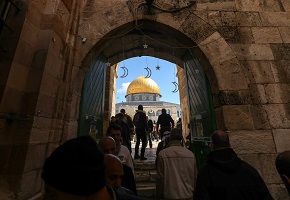
The Gaza war is a reminder that the Europeans left behind an unstable status quo a century ago. Absent a Sunni consensus, Iran is making an indirect power play. Iran’s weakness is also a strength: as non-Arab, Shiite Muslims, Iran’s leaders can’t trace their ancestry to the prophet Muhammad’s qureysh tribe—as can Jordan’s and Morocco’s monarchs, and as ISIS’s Abu Bakr al-Baghdadi claimed. Though around 85 percent of Muslims are Sunni, the demography of global Islam has long favored much larger non-Arab populations. The dynamic might be resolved with a Vatican City-style solution for Al Aqsa.
We use cookies to ensure that we give you the best experience on our website. If you continue to use this site we will assume that you are happy with it.Ok