
israel-hamas-war
  • In an article published in January in Foreign Affairs, two researchers analyze the extreme volatility of the current global order, arguing that in the age of personalist politics key foreign policy decisions—especially those involving great powers and nuclear-armed states—depend largely on the whims and obsessions of individual leaders, rather than on stable institutions or long-term strategies. In this new global order, instability is the norm, because decisions no longer correspond to long-term strategic expectations and interests, but are the result of impulsive choices unconstrained by institutional considerations and commitments. This dynamic is illustrated by what is not happening in Gaza, which has officially entered the ‘phase two’ of the twenty-point peace plan launched by US President Donald Trump—a plan that was supposed to ensure the Strip’s demilitarization, a technocratic government, and the long-awaited beginning of reconstruction.
  • Pegah Zohouri 6 November 2025
    Over the past two years, Iran has suffered the most significant blows to its deterrence capacity since the founding of the Islamic Republic, losing much of the regional influence it once wielded through loyal proxies in Iraq, Syria, Lebanon, and even Yemen. Once able to mobilize allied forces across the Middle East in pursuit of shared interests against Israel, Tehran now faces a drastically diminished strategic position. Following Hamas’s October 2023 attacks, Israel systematically targeted Iranian proxies—crippling Hamas in Gaza, weakening Hezbollah in Lebanon, and, with the collapse of Bashar Al-Assad’s regime in December 2024, depriving Iran of its crucial Syrian ally. Subsequent Israeli strikes deep into Iranian territory further exposed Tehran’s intelligence failures, limited military reach, and diplomatic isolation. Yet the current retrenchment of Iran and its allies does not signify collapse; rather, it represents a phase of strategic recalibration within an evolving regional order characterized by multi-alignment and shifting power centers.
  • Alessandra Tommasi 6 November 2025
    Two years after October 7, the Middle East is undergoing a profound transformation. Israeli assertiveness, Iran’s weakening influence, and the reshaping of al-Sharaa’s Syria are redefining the regional balance, while fragile truces and new hierarchies of power reveal a landscape still in flux. In this context, French political scientist and leading expert on political Islam, Olivier Roy, reflects for Reset DOC on the region’s prospects, the deadlock of the Palestinian question, and the evolving relationship between Israel and its neighbors.
  • Pasquale Ferrara 6 November 2025
    What are the defining features of the hypothetical “new Middle East” emerging after the tragic events of October 7, 2023? Beyond the unspeakable tragedy unfolding in Gaza—a catastrophe not only of immense humanitarian proportions but also of deep political inconsistency—several recent developments stand out. These markers help illuminate the ongoing attempt to reshape the region, not necessarily toward lasting stability, but more plausibly toward a provisional armistice. Such a phase, though conditional, would nonetheless be welcome if it could create the groundwork for a genuine space for negotiation on the fundamental issues of the conflict.
  • Alessandra Tommasi 26 September 2025
    After almost two years of war in Gaza and at least 65,000 Palestinians killed, recognition of Palestine as a state has become an urgent issue internationally. France and the United Kingdom recently recognized Palestine, joining other Western countries and bringing the tally to four of the five permanent members of the UN Security Council whose recommendation is required for recognition at the United Nations. Meanwhile, calls for a Palestinian state are multiplying. Among them is a petition by 60 Israeli NGOs, united under It’s Time, a coalition supporting a two-state solution that organized a peace summit in May. Reset DOC spoke with Raluca Ganea—co-founder and executive director of Zazim, a civic movement of Arabs and Jews working together for democracy and equality, and a member of It’s Time—about what is required to turn the vision of a two-state solution into a political reality.
  • The upheavals concerning the area we call the Holy Land, where Jesus preached and which today spans Israel and the Palestinian Territories, inevitably involve the Christians living there. To grasp their significance, it’s useful to start with a Franciscan who was a passionate scholar of Judaism, later becoming Custos of the Holy Land and then Latin Patriarch of Jerusalem—the first patriarch to become a cardinal, Pierbattista Pizzaballa. How can we define him? Using the term he chose when elected in 2020: the “patriarch of remaining.”
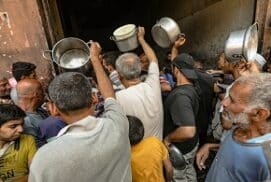
  • Many media outlets highlight how Israel is increasingly isolated in the West regarding Gaza. According to a Pew Research Center survey, the number of pro-Western states—above all Australia, Indonesia, Japan, and Turkey, and in Europe, Spain, Sweden, Greece, Ireland, and the Netherlands—that hold a negative perception of Israel is growing. The Israeli government and army continue to present the current military intervention—Operation “Gideon’s Chariots,” launched last May—as a necessary response to the “existential threat” posed by Hamas, while a growing part of the international community can no longer perceive any danger in the starving masses of Palestinians wandering around food distribution centers in constant danger of being killed.
  • “I’m proud to be called a normalizer by the Muslim Brotherhood’s affiliates.” That’s how Dubai-based blogger Loay Alshareef responds to attacks from across the Arab world, where the majority still oppose full recognition of the State of Israel. A practicing Muslim of Saudi origin, Alshareef doesn’t shy away from controversy: he openly defines himself as a “Zionist” and sees the Abraham Accords not as a betrayal of the Palestinian cause, but as a path to peace. On June 11, 2025, the activist and influencer took part in a roundtable discussion in Bologna, Italy, focused on combating antisemitism – an occasion on which Reset DOC spoke with him to share his views on the ongoing war in Gaza.
  • Hussein Ibish 24 February 2025
    Saudi Arabia hosted a meeting on February 21 with all six Gulf Cooperation Council countries plus the crucial additions of Egypt and Jordan to begin crafting a formal Arab response to President Donald J. Trump’s fantastical scheme to redevelop Gaza after removing its 2.2 million Palestinian residents. Trump’s supporters and officials claim that this sudden Arab urgency to respond with an alternative to his Gaza plan is a diplomatic achievement and the real purpose of his radical proposal. Yet whatever the Arab countries come up with at this GCC +2 meeting, or at the March 4 full convening of the Arab League, will not be practicable given Israel’s policies.
Load more
SUPPORT OUR WORK


Please consider giving a tax-free donation to Reset this year

Any amount will help show your support for our activities

In Europe and elsewhere
(Reset DOC)


In the US
(Reset Dialogues)


x