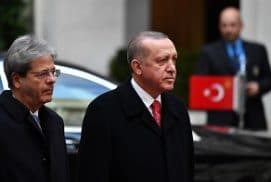
Before embarking on his European ‘renaissance tour’ Erdoğan had expressed his doctrine rather clearly, stating that, “we must reduce the number of our enemies and increase that of our friends.”
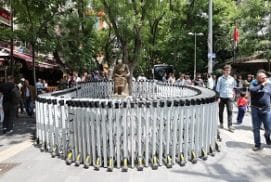
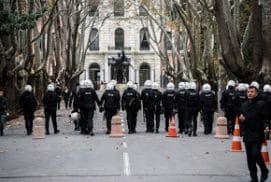
When in 1990 Turkish sculptor Metin Yurdanur was asked to design and carve a monument in honour of Human Rights to be placed in central Ankara, it was probably impossible to predict that the bronze statue of a girl sitting on a chair reading the declaration of Human Rights, sculpted by the Turkish artist, would have been one day “imprisoned”
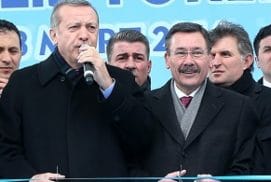
When Melih Gökcek was mayor of the Turkish capital of Ankara, Recep Tayyip Erdoğan appeared on the national stage as Istanbul’s highest ranking official. It was 1994 and victory in the nation’s two most important cities achieved by representatives of political Islam, marked a turning point in the balance of power in a country still largely in the hands of secular elites and governed by the army.
On October 18, Turkish Parliament passed a law allowing muftis to perform civil marriages. “Want it or not, this will be passed by the Parliament!” announced Turkish President Recep Tayyip Erdoğan in response to the opposition parties, women’s rights organisations, feminist associations and women’s right activists who have protested the bill since its draft version.
A little less than a year and a half after the attempted coup d’état, the political and social situation in Turkey continues to be extremely critical. The vice on the opposition and on civil society, which in spite of everything continues the struggle in defence of democratic rights, becomes tighter every day.
After the failed coup attempt in Turkey in 2016, the AKP set about securing what Recep Tayyip Erdoğan referred to as ‘social and cultural power’. Nilgün Tutal studies processes of Islamisation in Ankara and Istanbul, showing how the political struggle in Turkey is about the imposition of a ‘legitimate’ cultural vision.
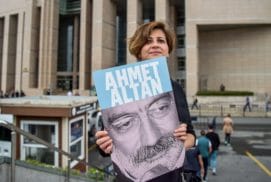
Ahmet Altan was imprisoned in Turkey with his brother Mehmet in September 2016. Despite being denied access to receiving and sending written communications, he wrote The Writer’s Paradox for publication on the eve of his trial, which starts on 19 September
Our 9 year long Istanbul Seminars have established themselves as a recognizable cultural fixture for a remarkable community of scholars. It has been able to promote and consolidate a network of cultural, intellectual and academic relationships among senior and junior scholars of the social sciences, political theory, sociology, legal and religious studies. Explore our Istanbul Seminars archive.
In Turkey, the curtailment of academic freedom and the diminishing autonomy of universities, that assumed unprecedented dimensions after the failed coup attempt, attracted increasingly attention both in the Turkish and international media. Ayse Caglar gives an in deep analysis on the inner workings and the consequences of these assaults on academic institutions, in order to highlight the politics of law in this regime’s authoritarian form of governance.
Armed conflicts, civilians debased by both terrorist groups and dictatorial governments, a worrying repression of dissent and waves of populism and racism experiencing a staggering rise
We use cookies to ensure that we give you the best experience on our website. If you continue to use this site we will assume that you are happy with it.Ok