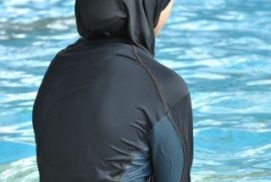
Once upon a time, not that long ago, it was a crime to go to the beach wearing skimpy clothes. Nowadays, at least in France, it is crime to appear on a beach if excessively overdressed. Bikinis and topless swimsuits were forbidden in the name of rules governing public morals and behaviour that forbade women from showing off too much of their bodies. According to Prime Minister Manuel Valls, burkinis are not compatible with new French public morals established by the republic’s values and women’s emancipation. An excessively covered-up woman is not sufficiently secular and independent.
According to many recent studies, Muslims’ political history reveals certain particular processes and ideas, which is obvious since all historical processes differ, but at the end of the day result in one and the same universe encompassing them all and one that has ended up creating the practices, schools of thought and symbols adopted by Muslims. While, for example, this concerns Islam’s political language, or kingdom of God, or oriental despotism, etc., it appears to evoke a universe that is totally extraneous to everything that Europe has practiced and believed. As one will see, in observing the events rocking the Muslim world, a contemporary researcher has even suggested that there has been a fall and resurrection of the Islamic State (overturning the words of the famous book, Decline and Fall of the Roman Empire).
This article explores the role of religion in Ottoman political legitimation. It shows that the Ottoman rulers were interested in a much more expansive, diverse form of political legitimation that included Islamic religious legitimation, but also used toleration and sultanic law to construct a more capacious form of political legitimation that included Muslim and non-Muslim populations of the empire.
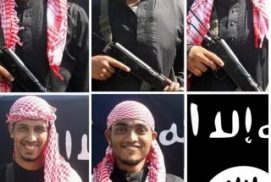
There is no country in the “Old Continent” left immune by the terrorist attacks carried out or at least inspired by the Islamic State, although the largest number of victims of this unusual violence is reported in Middle Eastern countries (especially in Syria, Iraq, Saudi Arabia, Tunisia, Egypt, Lebanon and Turkey) as the control of those territories conquered in the name of Jihad’s ideology in Syria and Iraq is becoming harder.
Only twice has Bangladesh made headline news in recent years: three years ago, when a complex of clothes factories collapsed in the suburbs of Dhaka killing over 1,200 people, and again last Friday when a group of armed men attacked a place patronised by Westerners killing 20 people, eighteen of them Westeners. The attack on the Holey Artisan Bakery, a café-restaurant in Dhaka’s most exclusive district, was not totally unexpected. There had been many signs indicating that Bangladesh, one of the poorest and most unstable countries in south Asia with 150 million inhabitants, of which the majority are Muslims, had sunk into a political crisis in which Islamist extremism is a destabilising force.
Is there an “Islamic State”? And can religiosity exist without freedom? No!, claims Islamic theologian Adnane Mokrani from Rome’s PISAI Institute and gives a political and historical explanation of why a secular State represents a real opportunity of religious freedom for Muslims
Whether “European Islam” is possible or not appears to be one of the controversial questions of our recent times. “Institutionalized ignorance” – in the words of Mohammed Arkoun – feeds mistrust, which in turn feeds fear. Fear becomes a prejudice, which in turn becomes a generalization; and generalizations are wrong. Thus, [institutionalized] ignorance is wrong. European arrogance seems to have forgotten the legacy of its earlier Enlightenment. Muslims’ moral order and Golden Age, long time passed, seems hijacked by terrorists. Wise moderates from both sides are needed more than any other times, and there are plenty of them. Bloody events in the name of politicized Allah, especially since the 1970s until the current horrendous massacres committed by the “Intolerant State” of ISIS nurture the stories that demagogues use to uphold their antagonistic views about each other.
From Reset-DoC’s Archive – For people of the Maghreb, or at least for those who are interested in the intellectual life, 2010 will undisputedly be associated with the heaviest harvest of intellectual and political figures of the region. As if death plotted against the region and decided to take away the emblematic figures of a glorious period of intellectual and political life. Mohamed Abid Al Jabiri, Edmond Emran El Maleh and Abraham Serfaty from Morocco; Mohamed Arkoun and Tahar Ouettar from Algeria and Nasr Hamid Abu Zayd from Egypt, took their leave in 2010. As much as these intellectuals’ works are widely studied in Western academia, especially in Europe and America, they remain unknown to large sections of the Arab world. Many factors inform this ignorance. First, the objective discontinuities that exist in terms of free circulation of knowledge between the Mashriq (the east of the Arab world) and the Maghreb (the west). Second, the historical jealousies that have always existed between the two sides of the Arab world. (This article was published on Reset-Dialogues on Civilizations in 2011)
The intellectual project undertaken by the Moroccan thinker and philosopher Muḥammad ‘Ᾱbid al-Ǧābirī, better known as Mohammed Abed al-Jabri (1935-2010), considered one of the greatest Arab intellectuals of the century, would not be entirely “explored” if one did not also take into account his work involving a discourse on the Qur’an. So far, studies on his work emphasise the originality of his ideas that have proved to be decisive for the development of Arab thinking, for example the discovery of the three “cognitive orders” (bayān, ‘irfān and burhān), which have contributed significantly to the formation of Arab reasoning; just like the epistemological critique of Arab-Islamic cultural traditions (turāṯ) which resulted in a totally new perspective, thanks to an original approach in engaging with the past. The Muslim world was encouraged to reread, review and therefore also better understand its own cultural traditions so as to relate to modernity. But how could Islam’s relationship with modernity be re-established through the Koran and all the religious tradition gravitating around it? What is known of the “Koranic phenomenon”?
The late Egyptian theologian Nasr Hamid Abu Zayd (10 July 1943 – 5 July 2010) was destined to be an Azharite sheikh, but the death of his father when he was fourteen, and the obligations of life led him to contribute to family household from an early age. However, he did not leave his scholarly thirst; he got his PhD in 1981 with a thesis on “The Philosophy of Interpretation: Mohi Eddin Ibn Arabi’s Method of Interpreting the Quran.” He belonged to the Muslim Brotherhood in Tanta in 1954, worked in Radio, and held lectureships and fellowships in Sudan, the USA, Japan, and the Netherlands; he received scholarly rewards for his works from Tunisia, Jordan and other international institutions. He was the student and colleague of the living famous philosopher Hassan Hanafi (b. 1935), whose project of the Islamic Left he (Abu Zayd) critiques especially in Critique of Religious Discourse (1990). He also met in scholarly discussions with contemporary philosophers-theologians like Sadeq al-Azmeh, Mohammed Arkoun, Abdolkarim Soroush, and Mohammad Amareh. Nasr Hamid Abu Zayd will be remembered as a staunch rationalist and liberal theologian that defends three major values from within his own Islamic faith – reason, liberty, and justice. In his own words, “Islam truly liberated man”; to recover that achievement, re-interpreting the Sacred Text is a must for renewed liberation, based on considering “this-world” the essence of existence. This is an homage to his great contributions at the age of Arab-Islamic intellectual predicament, and political turmoil led by bloody hijackers of the Quran.
Please consider giving a tax-free donation to Reset this year
Any amount will help show your support for our activities
In Europe and elsewhere (Reset DOC)
In the US (Reset Dialogues)
x
We use cookies to ensure that we give you the best experience on our website. If you continue to use this site we will assume that you are happy with it.Ok