
reconciliation
  • Editorial Board 22 January 2026
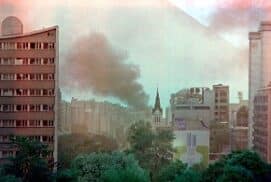
    From the siege of Sarajevo to the genocide of Srebrenica, religion during the Balkan wars of the 1990s was mobilized to legitimize violence, define enemies, and morally justify exclusion, hatred, and mass killing. With the end of the war and the implementation of the Dayton Accords, a new question emerged: what role can religious communities play once the guns fall silent? Reset’s new documentary by Filippo Macelloni, “Religion and Reconciliation in Bosnia-Herzegovina & the Balkans”, delves into the impact of religion on reconciliation and peacebuilding, starting at the heart of it all: Sarajevo.

  • Editorial Board 23 October 2024
    The ecclesiastical ties between Russia and Ukraine are crucial to understanding the ongoing conflict and envisioning peace. Ukraine’s Orthodox community is divided, with over half aligning with the autocephalous Kyiv Patriarchate established in 2019, while 40 percent remain loyal to the Moscow Patriarchate, which views Kyiv as the birthplace of Russian Orthodoxy. Recently, all three branches of the Ukrainian Orthodox Church have declared independence from the Russian Orthodox Church, distancing themselves from Patriarch Kirill’s support for the war. Will faith overcome power politics and help to bring peace to the region?
  • Rajeev Bhargava, Centre for the Study of Developing Societies, India 1 June 2013
    Two notions of reconciliation exist. The weak or thin conception is akin to 'resignation'. It is sought by groups that have waged war against one another but have come to the realization neither can win. Reconciliation in this sense results from an enforced lowering of expectations. In the stronger sense, reconciliation means a virtual cancellation of enmity or estrangement via a morally grounded forgiveness, achievable only when conflicting groups acknowledge collective responsibility for past injustice, and shed their deep prejudices by a profound and painful transformation in their identities. It is because this process is not possible without a somewhat brutal confrontation with oneself and a painful recognition of one’s own moral degradation that reconciliation is difficult to achieve.
Load more
SUPPORT OUR WORK


Please consider giving a tax-free donation to Reset this year

Any amount will help show your support for our activities

In Europe and elsewhere
(Reset DOC)


In the US
(Reset Dialogues)


x