

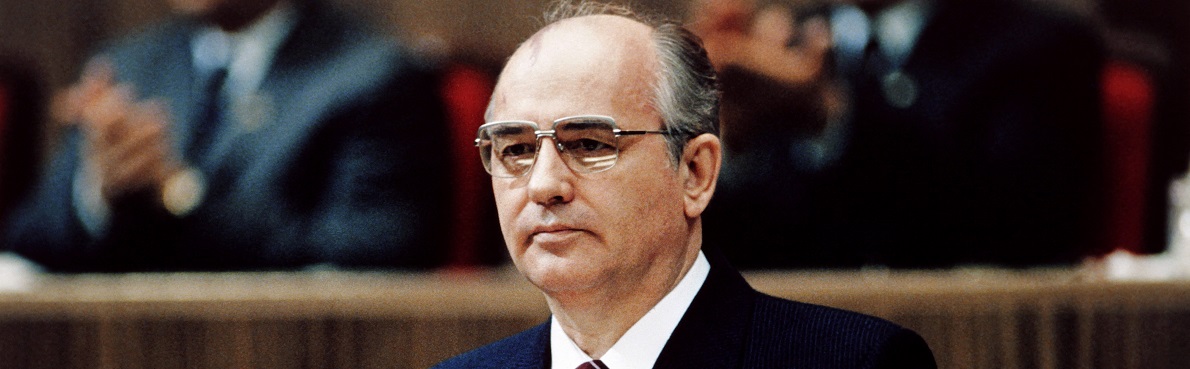

Mikhail Gorbachev, the last president of the Soviet Union and one of the leaders who decisevely helped defuse and bring to an end the Cold War, died yesterday in Moscow at 91. We come back on the legacy of his action on Russia’s and global history by republishing this conversation with historian Andrea Graziosi realized in October 2009, in the occasion of the twentieth anniversary of the Berlin Wall fall.
This is the twentieth anniversary of 1989. Can one say that without Gorbachev the revolutions in the east would not have taken place?
Absolutely correct. The USSR had the means to stop this process. It had the military and political capacity to stop them as well as approval from the West, where the idea that the East was part of the Soviet sphere was not even up for discussion. Without a decision taken in Moscow, the events of 1989 would never have happened.
To what extent did perestroika influence these events?
Perestroika greatly influenced these events, because it started change in the East and overturned the dynamics that had until then characterised the communist area, where any sense of reform – with the exception of a brief period in 1953 – had always come from central-eastern European capitals such as Budapest, Prague and Warsaw. With perestroika, the direction of reforms changed, moving from Moscow to popular democracies. Wherever the opposition became courageous and, after the Soviet withdrawal from Afghanistan, Moscow’s lack of intervention in the Azerbaijan-Armenian war (1988) and Gorbaciov’s speech at the UN announcing a self-reduction of armaments in the East, people realised that the USSR would not use force to keep popular democracies linked to itself. In the meantime, however, Gorbachev realised that East Germany, Czechoslovakia, Hungary and Poland had become unbearable burdens. The economic and political cost of keeping those regimes alive had become unsustainable and Moscow needed look to, above all, its own very uncertain future.
Do you mean that Gorbachev had already understood that perestroika would not have succeeded?
Gorbachev started to understand this in 1987. During the previous two years very drastic reform therapies had been applied. There was a battle without quarter against corruption, and massive investments in modern technology; but all this because they were persuaded that the structure was strong and just needed re-polishing. This was also a thesis adopted by Andropov. The point is however that if a structure is rotten and there is an attempt to shake it, the result is an even more serious crisis. This is what happened with perestroika, to the extent that towards the end of ’87, when he became aware of this, Gorbachev moved against the system. One could say that between the end of 1987 and the beginning of 1988, although remaining a socialist, Gorbachev became anti-soviet, which was reflected in his decision to abandon the Party in favour of the State. He made this choice too late, because it was precisely in 1988 that nationalism re-awoke in the Union’s various republics and the centrifugal thrust accelerated the collapse.
Did the failure of perestroika confirm that Soviet-styled communism could not be reformed and that the defeat suffered by Moscow in the Cold War was caused by this?
A premise is necessary here. If one considers the history of Eastern Europe, political defeat did not occur with the fall of the Berlin Wall; defeat matured much earlier with the Marshall Plan. The Americans were offering money, the USSR only offered a military presence and subjugation. The long series of acts of intolerance in Czechoslovakia, Poland and Hungary, certified that Soviet domination was perceived as coercion and this the Berlin Wall became the symbol of the 1947 defeat, as it represented the USSR’s inferiority to America and of the East compared to the West. That said, everything can be reformed, but reforms depend of the cultural element adopted. That of the Soviet elite was communism, Marxism and real socialism. Moscow had had a great opportunity for change between 1953 and the first years in which Brezhnev was in power. To some extent this opportunity was exploited, but at a certain point the Kremlin stopped. The invasion of Prague in 1968 also confirms that there was a line that could not be crossed. This does not mean that they could not and should not have implemented reform, even very brutal ones. There was an awareness within the Soviet elite that the system could be changed only by resorting to shocks. Things started with Brezhnev, continued with Andropov and accelerated with Gorbachev, whose elections without opposition indicated that they all agreed that widespread reform was necessary. But the problem – as previously mentioned – was that the Soviets believed that beneath a layer of inefficiency there was still a system capable of working. It was not however a given that the USSR would collapse. They could have chosen the Chinese option. One Party and capitalism. But the leaders, once again the issue of the cultural element, believed in socialism.
How are the events of 1989 and 1991 perceived in today’s Russia?
Rather than 1989 and 1991, it is the Soviet period as a whole that is analysed. In the middle-classes of the population the past is seen as power and glory. Hence, the collapse of the communist world is seen as a sort of national humiliation. Those years should however be reassessed. The USSR ended peacefully as did domination over the East. Gorbachev and Yeltsin deserve to be acknowledged for this. To tell the truth not even the 1991 coup participants wanted to use force, with the exception of a few generals who were silenced and excluded. Therefore, the whole of the Soviet group of leaders, even those not in favour of reform, did leave a good impression.
Translated by Francesca Simmons
Mikhail Gorbachev, then General Secretary of the Communist Party of the Soviet Union, speaking during a celebration for the 40th anniversary of the victory in WW2 – Moscow, May 8, 1985 (TASS / AFP).
Follow us on Facebook, Twitter and LinkedIn to see and interact with our latest contents. If you like our analyses, events, publications and dossiers, sign up for our newsletter (twice a month) and consider supporting our work.